AI SEO Services: What's Real, What's Hype, and How We Actually Use It
.webp)
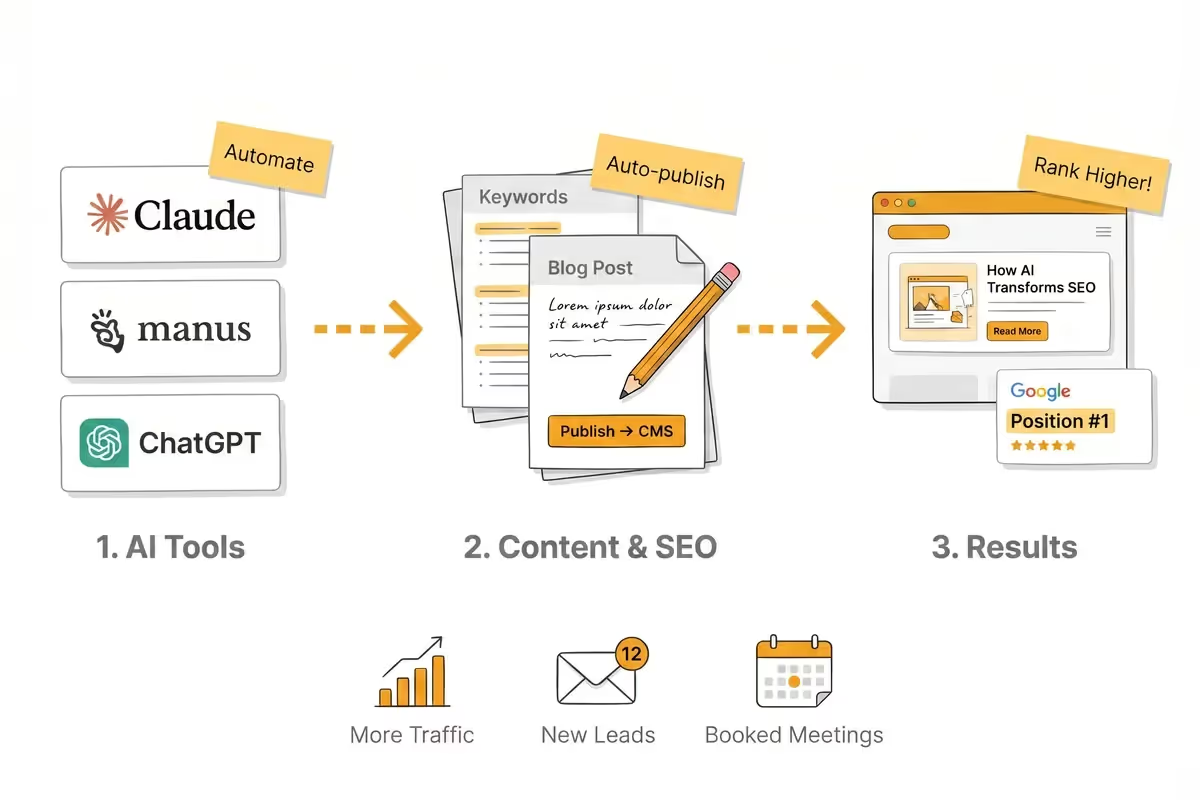
Table of content

Overview:
A lot of agencies added "AI" to their service pages this year. Most of them mean they're using ChatGPT to write blog posts faster. That's not AI SEO services. That's a writing shortcut with a marketing label on it.
Real AI-powered SEO is a connected system. It's using APIs to pull live keyword data, AI to analyze competitors and build strategy, MCP connections to read and update your actual website, and tools like Manus and Claude to do research that would take a human team weeks. We run this workflow for our own site and for clients. This article shows you exactly how it works.
Fast Lane
Quick Access: Jump to a section below:
TL;DR
- Real AI SEO services use APIs, MCP connections, and AI models across the entire workflow, not just for writing
- AI pulls live keyword data, analyzes competitors, audits your existing content, and identifies gaps in minutes
- MCP (Model Context Protocol) lets AI connect directly to WordPress, Webflow, and other platforms to read and update your site
- We used this system for an architecture firm: audited their content, analyzed rankings, updated existing articles, and built a plan for new content
- AI accelerates execution but doesn't replace strategy. The human layer decides what's worth pursuing and why.
What AI SEO Services Actually Are (And What They're Not)
There are two versions of "AI SEO" being sold right now:
Version 1: The rebrand. An agency uses ChatGPT to write blog posts faster. They call this "AI-powered SEO." The strategy, keyword research, and publishing process haven't changed. The only difference is the writing tool.
Version 2: The system. AI is connected to every step. Keyword research runs through APIs that pull live search data programmatically. Competitor analysis uses AI to crawl ranked pages, identify content gaps, and score opportunities. The AI connects directly to your CMS through MCP to audit existing content and push updates. Content is drafted with AI, edited by humans, and published through API. The pipeline from research to live article is faster, more data-driven, and repeatable.
Version 2 is what ai seo services should look like. If you're paying for Version 1, you're paying for a writing assistant.
📌 Pro Tip: Ask any agency that claims to use AI: "Walk me through how AI touches your keyword research, competitor analysis, content audit, and publishing." If the answer only covers content writing, that's all the AI they're using.
AI for Keyword Research: API-Driven Data Instead of Manual Exports
Traditional keyword research means opening a tool, typing a seed keyword, exporting a CSV, and manually sorting through rows. It works, but it's slow and limited by whatever the tool's interface shows you.
AI-driven keyword research is different. We connect directly to search data APIs like DataForSEO and pull keyword suggestions, search volumes, CPC data, keyword difficulty, and competitive rankings programmatically. Instead of browsing one keyword at a time, we pull thousands of data points in a single query.
Then AI does the heavy lifting. We feed that raw data into Claude, which clusters keywords by topic and search intent, scores them by commercial value (high CPC means someone is paying real money for that click), and maps them into content clusters with pillars and supporting articles. What takes a strategist a full week of spreadsheet work happens in an afternoon.
When we built our own content strategy, we pulled data for over 180 keywords across five topic clusters. The API returned real search volumes, CPC signals, and difficulty scores. AI analyzed the full dataset and identified that "seo services for small business" had the best combination of volume (8,100 monthly searches), low competition (KD 13), and hire intent ($79 CPC). That became our first pillar article.
| Approach | Traditional Research | AI + API Research |
|---|---|---|
| Data source | Tool UI (manual exports) | Direct API (DataForSEO, Google Ads API) |
| Scale | 50–100 keywords per session | 500–2,000+ keywords per query |
| Analysis | Manual sorting and filtering | AI clusters by topic, intent, and commercial value |
| Time | 1–2 weeks | 1–2 days |
| Output | Spreadsheet of keywords | Mapped content strategy with clusters and priorities |
AI for Competitor Analysis: See What's Ranking and Why
Competitor analysis used to mean manually checking who ranks for your target keywords and trying to reverse-engineer their strategy. Now AI does this systematically.
We use DataForSEO's ranked keywords endpoint to pull every keyword a competitor's domain ranks for, their position, estimated traffic, and the pages driving that traffic. Feed that into AI and it identifies patterns: which topics they're winning on, where their content is thin, and where the gaps are that you can exploit.
Tools like Manus take this further. Manus can research competitors across the web, analyze their content strategies, and surface insights that would take a human researcher hours to compile. It's particularly useful for understanding how competitors position themselves, what questions they're answering, and what they're missing entirely.
We combine these tools with Claude to build a complete competitive picture. Claude reads the data, compares it against your existing content, and produces a gap analysis that shows exactly where you have opportunities to outrank competitors with better, more targeted content.
📌 Pro Tip: Don't just look at what competitors rank for. Look at the keywords they rank on page 2 for. Those are terms they've invested in but haven't won yet. If you produce better content targeting those same terms, you can leapfrog them.
MCP: How AI Connects Directly to Your Website
This is the part most people haven't heard of yet, and it's what separates real AI SEO from everything else.
MCP (Model Context Protocol) is an open standard that lets AI models connect directly to external tools and platforms. For SEO, this means Claude can connect to your Webflow site, your WordPress install, your DataForSEO account, and your analytics, all in the same session.
Here's what that looks like in practice:
Content audit. Instead of manually reviewing every page on your site, AI connects through MCP, pulls all your published articles, reads the content, checks the meta tags, evaluates the keyword targeting, and flags what needs updating. For a site with 50 articles, this takes minutes instead of days.
Direct publishing. Once an article is written and approved, we push it directly to your CMS through MCP or API. For Webflow, that means title, slug, meta tags, body content, FAQ fields, and images all get published in a single operation. For WordPress, MCP connections let AI read existing posts, update content, adjust metadata, and publish, all without logging into the admin panel.
Cross-platform workflow. In a single session, AI can pull keyword data from DataForSEO, analyze your current rankings, audit your existing content through your CMS connection, identify which articles need updating, draft the updates, and push them live. Every step that used to require a different tool and manual handoffs now runs in one connected workflow.
| MCP Connection | What It Does for SEO |
|---|---|
| Webflow MCP | Read/write CMS items, update page content, manage blog articles, push metadata |
| WordPress MCP | Audit existing posts, update content, manage categories and tags, publish articles |
| DataForSEO MCP | Pull keyword data, ranked keywords, competitor analysis, backlink data in real time |
| Google Drive / Docs MCP | Read briefs, share drafts, collaborate on content without leaving the AI workflow |
⚠️ Warning: MCP connections give AI direct access to your site. Any provider using this should have strict safety rules: no publishing without approval, no changing live slugs, no deleting content. We run every publish through an explicit approval step. If an agency can't explain their safety process, don't give them access.
Want to See This System in Action?
We'll show you exactly how we'd connect AI to your website and build a data-driven SEO strategy for your business.
👉 Get Your AI SEO StrategyAI for Content: Where It Helps and Where It Doesn't
AI produces solid first drafts. Give it a keyword, a target audience, an article outline, and brand voice examples, and it will get you 70–80% of the way there. It's also strong at generating FAQ content, meta descriptions, comparison tables, and structured sections.
Where it falls short: AI doesn't know your business. It can't tell the story of how your best client found you through a Google search and turned into a $200K project. It doesn't have opinions shaped by experience, and Google's helpful content guidelines increasingly reward content that demonstrates first-hand expertise.
The approach that works: AI writes the structure and first draft. Humans add the expertise, the client stories, and the brand voice. Every article we publish goes through this process.
How We Used AI SEO for an Architecture Firm
Here's the full workflow we ran for an architecture firm with offices in San Francisco and LA. This shows what AI SEO services look like when every tool is connected.
Step 1: Connected to their website. We used MCP to connect directly to their site, pulled every published page and blog article, and had AI read through the entire content library. Within minutes, we had a complete picture of what they'd published, how it was structured, and what keywords each page was targeting (or failing to target).
Step 2: Analyzed what they rank for. We pulled their ranked keywords through DataForSEO's API. AI analyzed the full dataset and found that most of their organic traffic came from branded searches and a handful of project-type keywords. Dozens of high-value keywords in their space had zero coverage on their site.
Step 3: Competitor analysis. We pulled ranked keywords for three competing architecture firms in their market. AI compared the datasets and identified the specific topics where competitors were capturing traffic that the firm wasn't. This gave us a prioritized list of content gaps.
Step 4: Updated existing content. Before writing anything new, we updated their existing articles and pages based on the keyword data. AI drafted updated meta titles, descriptions, and on-page copy targeting the keywords each page should have been ranking for. We reviewed, approved, and pushed the updates.
Step 5: Built the next phase. With the existing content optimized, AI mapped out the next 10 articles: pillar content for their highest-value services, supporting articles targeting long-tail keywords, and industry-specific pages. Each article had a target keyword, search volume, difficulty score, and content brief before a single word was written.
The result: organic traffic grew 40% in three months. Then we layered in lead generation (CRM, email sequences, outreach) and turned that traffic into project inquiries. Over the engagement, we generated 200+ leads.
What AI Still Can't Replace
Business context. AI doesn't know your margins, your best customer segments, or which services you want to grow. A keyword might have high volume, but a strategist decides whether ranking for it will generate profitable leads for your specific business.
Relationship-based link building. The best backlinks come from partnerships, guest contributions, and industry associations. AI can identify targets, but a human builds the relationships.
Brand voice at scale. AI can mimic a voice if you give it strong examples, but it drifts over multiple articles. Every piece needs a human pass to keep it sounding like you.
Judgment calls. Should you chase a high-volume keyword that's tangential to your business, or a lower-volume keyword with stronger buyer intent? AI presents the data. A strategist makes the call.
How to Evaluate an Agency Offering AI SEO Services
Ask them to name the tools. A real AI SEO operation can tell you which APIs, models, and platforms they use. "Proprietary technology" with no specifics usually means ChatGPT and a template.
Ask how AI connects to your site. If they can't explain MCP or API connections to your CMS, they're not running a connected workflow. They're writing content separately and pasting it into your backend manually.
Ask about competitor analysis. How do they identify what to target? If the answer is "we do keyword research," push further. Do they pull competitor ranking data through APIs? Do they use AI to analyze content gaps? A real AI-driven agency can show you the data pipeline.
Ask to see the human layer. If they claim AI does everything end-to-end with zero human involvement, the content will be generic. Good ai seo services have a clear human review step where strategy, voice, and expertise get added.
Look at their own site. If their blog reads like AI filler, imagine what your content will look like. If their content is specific, opinionated, and clearly backed by real experience, that tells you more than any sales call.
For a full breakdown of what to look for in any SEO provider (AI or not), read our guide on SEO services for small business.
Ready to See What AI-Driven SEO Can Do for Your Business?
We build SEO strategies using the same AI-powered workflow described in this article. Data-driven research, connected tools, and a system that compounds over time.
👉 Talk to Us About AI SEOFAQ's
What are AI SEO services?
AI SEO services use artificial intelligence across the entire SEO workflow, not just content writing. This includes API-driven keyword research using tools like DataForSEO, AI-powered competitor analysis with tools like Manus and Claude, MCP connections that let AI read and update your website directly, and automated content audits that identify optimization opportunities. The difference between real AI SEO and basic AI writing is that every step from research to publishing is connected through APIs and AI models.
How does AI help with keyword research for SEO?
AI connects directly to search data APIs like DataForSEO to pull keyword suggestions, search volumes, CPC data, and keyword difficulty programmatically. Instead of manually exporting and sorting spreadsheets, AI analyzes thousands of keywords at once, clusters them by topic and search intent, scores them by commercial value, and maps them into content strategies with pillars and supporting articles. What takes a human strategist a week of spreadsheet work happens in an afternoon.
What is MCP and how does it relate to SEO?
MCP (Model Context Protocol) is an open standard that lets AI models connect directly to external platforms like Webflow, WordPress, and DataForSEO. For SEO, this means AI can read your existing website content, audit meta tags and keyword targeting, push content updates, and publish articles directly through your CMS without manual copy-pasting. It turns disconnected SEO tasks into a single connected workflow where research, analysis, and publishing happen in one session.
Can AI replace human SEO strategists?
No. AI accelerates research, analysis, and content drafting, but it can't replace business context, relationship-based link building, brand voice consistency, or strategic judgment calls. A keyword might have high search volume, but a human strategist decides whether ranking for it will generate profitable leads for your specific business. The best results come from AI handling data processing and first drafts while humans add expertise, client stories, and strategic direction.
How do I know if an agency is really using AI for SEO?
Ask them to name the specific tools, APIs, and models they use. Ask how AI connects to your website (MCP or API connections to your CMS). Ask them to walk through how AI touches keyword research, competitor analysis, content auditing, and publishing. If the answer only covers content writing, that's the extent of their AI usage. A real AI SEO operation can show you the data pipeline from research through to published content.