What is a Digital Marketing Ecosystem: Your Complete Guide to Connected Marketing
.webp)
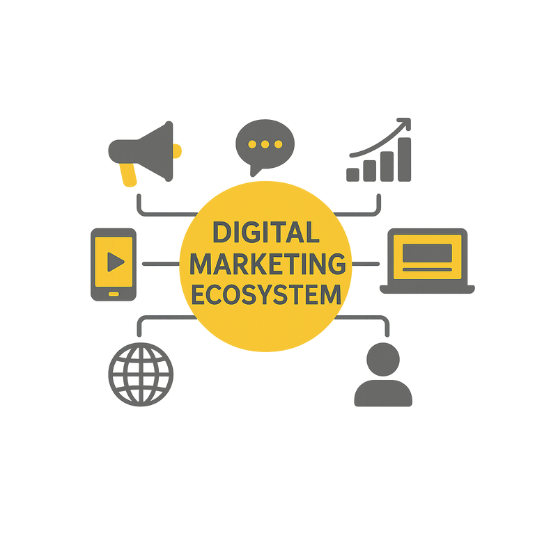
Table of content

Overview:
Remember when marketing meant placing an ad in the newspaper, running a TV commercial, and hoping for the best? Those days are long gone. Today's marketing landscape is far more complex, interconnected, and powerful than anything we've seen before. Welcome to the digital marketing ecosystem.
If you're feeling overwhelmed by terms like SEO, PPC, content marketing, social media strategy, email automation, and analytics dashboards, you're not alone. But here's the thing: these aren't separate, isolated tactics.
They're interconnected parts of a larger system that works together to attract, engage, and convert your audience. Understanding how these pieces fit together is the difference between throwing money at random marketing tactics and building a sustainable growth engine for your business.
In this guide, we'll break down exactly what a digital marketing ecosystem is, why it matters for your business, and how you can build one that actually delivers results.
Whether you're a small business owner trying to make sense of digital marketing or a marketer looking to optimize your strategy, this comprehensive look at the ecosystem will give you the clarity you need.
Fast Lane
Quick Access
- Understanding the Digital Marketing Ecosystem Concept
- The Core Components of a Digital Marketing Ecosystem
- Building Your Own Digital Marketing Ecosystem
- Common Pitfalls and How to Avoid Them
Understanding the Digital Marketing Ecosystem Concept
Let's start with a clear definition. A digital marketing ecosystem is the complete network of interconnected digital channels, platforms, tools, technologies, and strategies that businesses use to reach, engage, and convert their target audience.
Think of it like a natural ecosystem where different organisms interact and depend on each other. In your marketing ecosystem, each component plays a specific role while supporting and enhancing the others.
The key word here is "interconnected." This isn't just a collection of marketing tactics you happen to be using. A true ecosystem has intentional connections where data, insights, and customer interactions flow seamlessly between components. Your social media efforts inform your content strategy.
Your email campaigns drive traffic to your website. Your SEO efforts support your paid advertising. Everything works together toward common goals.
The Evolution from Single-Channel to Ecosystem Thinking
This ecosystem approach emerged out of necessity. The digital landscape became too complex and fragmented for single-channel strategies to succeed.
Customers don't interact with brands in a straight line anymore. They might discover you on Instagram, research on Google, read reviews on third-party sites, sign up for your email list, and finally make a purchase weeks later.
Your marketing needs to be present and consistent across this entire journey.
What Makes an Ecosystem Different?
What makes an ecosystem different from just doing multiple types of marketing? Integration, data sharing, and strategic alignment. In a disjointed approach, your social team doesn't know what your email team is doing.
Your content isn't optimized for the keywords your paid search team is targeting. Your website analytics don't inform your social media strategy. An ecosystem eliminates these silos and creates a unified, intelligent system.
The Key Benefits of an Ecosystem Approach
The benefits are substantial. Ecosystems are more efficient because components work together rather than competing for resources. They're more effective because consistent messaging reinforces itself across channels.
They're more adaptable because integrated data gives you clearer insights about what's working. And they're more sustainable because they build long-term audience relationships rather than relying on one-off tactics.
The Core Components of a Digital Marketing Ecosystem
1. Content Marketing: The Foundation of Your Ecosystem
Content marketing sits at the heart of most successful digital marketing ecosystems. It's the fuel that powers your other channels and the value you provide to attract and retain your audience. Without quality content, your social media has nothing to share, your SEO lacks substance, and your email campaigns fall flat.
What content marketing includes:
Blog posts and articles that address your audience's questions and pain points. Video content ranging from educational tutorials to product demonstrations.
Podcasts that build deeper relationships through long-form conversations. Infographics and visual content that simplify complex information. E-books, whitepapers, and guides that establish authority and generate leads. Case studies and testimonials that build trust and credibility.
The beauty of content marketing is its compound effect. A single well-crafted blog post can attract organic search traffic for years, be shared across social platforms dozens of times, provide material for multiple email campaigns, and serve as the basis for various other content formats. It's the gift that keeps giving.
How content integrates with other ecosystem components:
Your content feeds your SEO strategy by targeting relevant keywords and earning backlinks. It provides material for social media posts and engagement. Email newsletters distribute your content to subscribers. Paid advertising can amplify your best-performing content. Analytics show you which content resonates, informing future creation.
Quality content marketing isn't about churning out as much as possible. It's about creating valuable, relevant material that serves your audience's needs while advancing your business objectives.
The content you create should map to different stages of the customer journey, from awareness-building thought leadership to decision-stage comparison guides.
Practical implementation:
Develop a content calendar that aligns with business goals and seasonal trends. Create content clusters around core topics to establish topical authority.
Repurpose content across formats—turn blog posts into videos, podcasts into articles, webinars into multiple shorter pieces. Use audience research and keyword data to inform topics. Establish clear quality standards and a consistent brand voice.
2. Search Engine Optimization (SEO): Your Visibility Engine
SEO is how you make sure people can actually find all that great content you're creating. It's the practice of optimizing your digital presence so search engines understand, value, and rank your content when people search for relevant topics. In a healthy ecosystem, SEO isn't a separate activity—it's woven into everything you do online.
The three pillars of SEO:
Technical SEO ensures your website is crawlable, fast, mobile-friendly, and structured in ways search engines can easily understand. SEO Services includes site architecture, page speed optimization, structured data markup, and security protocols.
On-page SEO involves optimizing individual pages with relevant keywords, quality content, proper heading structure, meta descriptions, and internal linking. Off-page SEO builds your site's authority through backlinks, brand mentions, and reputation signals from other websites.
SEO's role in the ecosystem:
SEO research informs your content strategy by revealing what your audience is actually searching for. It drives qualified organic traffic to your website without ongoing advertising costs.
The credibility of ranking well in search results enhances trust across all channels. SEO data provides insights about audience intent and behavior that inform other marketing decisions.
Modern SEO has evolved far beyond keyword stuffing and link schemes. Search engines have become sophisticated enough to understand context, intent, and quality.
This means SEO now aligns closely with good content marketing creating genuinely valuable content that serves user needs naturally attracts links, engagement signals, and rankings.
Integration strategies:
Align your content calendar with keyword research to ensure you're creating content people are searching for. Use SEO insights to optimize social media content and paid ad copy.
Ensure your email campaigns drive traffic to well-optimized landing pages. Monitor SEO performance metrics alongside other channel data to understand the full customer journey.
The long-term nature of SEO makes it an essential ecosystem component. While paid advertising stops working the moment you stop paying, SEO investments compound over time.
Content that ranks well continues delivering value months or years after creation, making SEO one of the highest ROI components of your digital marketing ecosystem.
3. Social Media Marketing: Your Engagement and Community Hub
Social media platforms serve multiple crucial functions in your digital marketing ecosystem.
They're discovery channels where new audiences find you, engagement platforms where you build relationships, customer service channels where you solve problems, and distribution networks that amplify your content reach.
Key social media functions:
Building brand awareness by reaching audiences where they already spend time. Creating community around shared interests, values, or problems your brand addresses.
Distributing content to drive traffic back to owned properties like your website. Listening to conversations about your brand, industry, and competitors. Providing customer support and building trust through responsive communication. Running targeted advertising to specific audience segments.
Platform diversity and purpose:
Each social platform serves different purposes in your ecosystem. LinkedIn excels for B2B marketing and thought leadership. Instagram and TikTok dominate visual storytelling and reaching younger demographics. Facebook offers sophisticated advertising tools and diverse audience reach. Twitter facilitates real-time conversations and industry discourse. YouTube serves as the second-largest search engine and excels for video content.
Social media integration points:
Content from your blog feeds social posts and conversation starters. Social listening informs content topics and SEO keyword targeting. Email list growth often happens through social media lead magnets.
Paid social amplifies organic content to new audiences. Social proof and user-generated content enhance website conversion rates. Analytics from social platforms reveal audience preferences and behaviors.
Successful social media marketing isn't about being everywhere at once. It's about identifying where your specific audience spends time and creating a consistent, valuable presence there. Quality beats quantity better to excel on two platforms than to mediocrely maintain five.
Best practices for ecosystem integration:
Develop a unified content strategy that adapts core messages for different platforms rather than creating entirely separate content for each. Use social media management tools that integrate with your CRM and analytics platforms.
Create feedback loops where social insights inform content creation and website development. Establish clear workflows for how leads from social platforms enter your email and sales processes.
4. Email Marketing: Your Direct Communication Channel
While social media platforms come and go and algorithm changes can devastate your reach overnight, email remains the channel you truly own. Your email list is a direct line to people who've explicitly chosen to hear from you, making it one of the most valuable assets in your digital marketing ecosystem.
Email's unique advantages:
You own the relationship no algorithm decides who sees your messages. Personalization capabilities far exceed other channels.
ROI consistently ranks among the highest of all digital marketing tactics. Direct response rates typically outperform social media. Automation enables sophisticated nurturing sequences without ongoing manual effort.
Types of email marketing:
Welcome series that onboard new subscribers and set expectations. Newsletter campaigns that regularly deliver value and maintain engagement. Promotional emails that drive specific actions like purchases or registrations.
Educational drip campaigns that nurture leads over time. Transactional emails that confirm actions and cross-sell or upsell. Re-engagement campaigns that win back inactive subscribers.
Email's ecosystem role:
Email converts website visitors into subscribers, starting longer-term relationships. It distributes your content directly to interested audiences. Segmentation and personalization based on behavior across other channels increase relevance.
Email drives traffic back to your website for conversions. It keeps your brand top-of-mind between active engagement periods. Automated sequences nurture leads your sales team isn't ready to contact yet.
Integration opportunities:
Connect your email platform with your CRM to ensure sales and marketing alignment. Use website behavior to trigger relevant email sequences. Pull social media followers onto your email list through lead magnets.
Segment email lists based on content engagement and purchase history. Use email data to create lookalike audiences for paid advertising. Test messaging in email before scaling to paid channels.
Modern email marketing platforms offer sophisticated automation and personalization capabilities.
You can create complex workflows where someone's behavior triggers specific email sequences, tags them in your CRM, alerts your sales team, and more all automatically. This level of integration makes email a central nervous system in many marketing ecosystems.
Building Your Own Digital Marketing Ecosystem
Creating an effective digital marketing ecosystem isn't about adopting every possible tool and tactic. It's about strategic selection, intentional integration, and continuous optimization. Here's how to approach building yours.
Start with clear objectives: Before selecting tools or channels, define what success looks like. Are you focused on brand awareness, lead generation, customer retention, or some combination? Your objectives determine which ecosystem components deserve priority and how you'll measure success.
Map the customer journey: Understanding how people typically move from awareness to purchase in your industry is crucial. Identify the touchpoints where your audience needs information, support, or encouragement. Your ecosystem should have strategic presences at each crucial stage rather than random activity everywhere.
Choose components strategically: You don't need every possible marketing channel. Start with the fundamentals a content-rich website with solid SEO, one or two social platforms where your audience actually exists, and email marketing.
Add additional components only when you have capacity to execute them well and clear reasons why they'll enhance results.
Prioritize integration from day one: Select tools and platforms that connect with each other. Look for marketing automation platforms that integrate with your CRM, email tools that connect with your website analytics, social media management tools that pull data from multiple sources.
The easier it is for data to flow between systems, the more ecosystem-like your marketing becomes.
Create documented processes: How does a blog post get created, published, shared on social, included in newsletters, and optimized for SEO? Document these workflows so everyone on your team understands how components connect. This prevents siloed work and ensures consistent execution.
Establish measurement frameworks: Decide which metrics matter for each component and how they roll up to overall business goals. Create dashboards that show how different channels contribute to conversions. Track not just individual channel performance but also how channels assist each other.
Start small and scale intentionally: It's better to do three things excellently than ten things poorly. Master the fundamentals before adding complexity. As you build capacity and see results, expand strategically rather than reactively.
The most common mistake businesses make is collecting marketing tools without integrating them into a coherent system. They have a website, social accounts, an email platform, and maybe some ad campaigns, but these components operate independently. Transforming this collection into an ecosystem requires intentional connection-building and strategic alignment.
Common Pitfalls and How to Avoid Them
Even with the best intentions, businesses often struggle when building their digital marketing ecosystems. Here are the most common mistakes and how to avoid them.
Silo mentality: When your social media team doesn't talk to your content team, and neither coordinates with email marketing, you don't have an ecosystem. You have isolated activities. Combat this by establishing regular cross-functional meetings, shared goals, and collaborative planning processes.
Shiny object syndrome: New marketing tools and platforms emerge constantly. Jumping on every trend dilutes your efforts and prevents mastery of core components. Evaluate new additions based on strategic fit and capacity, not hype.
Data overload without insights: Having analytics from ten different platforms means nothing if you're not turning that data into actionable insights. Focus on a few key metrics that actually inform decisions rather than drowning in vanity metrics.
Inconsistent messaging: When your brand sounds different across channels, you confuse rather than reinforce. Develop clear brand guidelines and messaging frameworks that apply across your entire ecosystem.
Neglecting owned properties: Social media and paid advertising are important, but they're rented land. Always prioritize building owned assets like your website, blog, and email list that create long-term value regardless of platform changes.
Conclusion
A digital marketing ecosystem isn't just a fancy term for doing multiple types of marketing. It's a strategic approach that recognizes how interconnected today's digital landscape has become. When your marketing components work together, sharing data and reinforcing messages, you create something far more powerful than the sum of its parts.
The businesses winning in today's competitive environment aren't necessarily those with the biggest budgets. They're the ones with the most thoughtful, integrated, and adaptive marketing ecosystems. They understand their customers' journeys, meet them at every touchpoint, and continuously optimize based on data flowing through their systems.
Building your ecosystem doesn't happen overnight. It's an iterative process of implementing components, connecting them, measuring results, and refining your approach. Start with the fundamentals, ensure they're working well together, then expand strategically as your capacity and expertise grow.
The alternative continuing with disconnected marketing tactics becomes less viable every day. Customer expectations for seamless, personalized experiences across channels aren't going away. The only question is whether you'll build an ecosystem intentionally or find yourself forced to react as competitors pass you by.
FAQ's
How is a digital marketing ecosystem different from a marketing strategy?
A marketing strategy is your plan for achieving goals, while an ecosystem is the interconnected system of tools and channels you use to execute that strategy. Your strategy guides what you build; the ecosystem is what you build.
Do small businesses need a full digital marketing ecosystem?
Absolutely, though it might be simpler than a large enterprise's ecosystem. Even small businesses benefit from integrated marketing where their website, social media, and email work together rather than operating in isolation.
What's the minimum viable digital marketing ecosystem?
Start with a content-rich website optimized for search, email marketing to capture and nurture leads, and one social platform where your audience actively engages. These three components, properly integrated, form a powerful foundation.
How much should I budget for building a digital marketing ecosystem?
Budgets vary wildly based on business size and goals. Focus less on absolute numbers and more on strategic allocation—invest in owned assets like your website and content, automate where possible, and scale paid channels based on proven ROI.
Can I build an ecosystem using free tools?
For early stages, yes. Free CRM tools, basic email platforms, and organic social media can form a functional ecosystem. However, as you grow, paid tools typically offer better integration, automation, and scalability that justify the investment.
How long does it take to see results from an ecosystem approach?
Some components like paid advertising show immediate results, while others like SEO and content marketing build over months. Most businesses see meaningful improvement in 3-6 months, with compound effects accelerating over time as components mature and integrate more deeply.
.webp)